

 Main menu
The Habit Loop Guide: 5 Practical Steps to Reprogram Your Behavior and Achieve Your Goals
Have you ever caught yourself moving through the day on autopilot, wondering who’s actually in the driver’s seat? One moment you’re checking a single notification, the next you’ve lost twenty minutes scrolling. That sense of powerlessness isn’t a character flaw or a motivation problem. It’s your brain doing exactly what it was designed to do: conserve energy.
The real mistake most people make is trying to change results without understanding the machinery producing them. That’s why willpower fades, resolutions collapse, and the same patterns resurface. Without touching the engine, you stay stuck in a loop of good intentions and disappointing follow-through.
This guide pulls back the curtain on the habit loop—the brain’s operating system—and shows you how to reprogram your behavior in a way that actually sticks.
Why Changing Habits Feels Harder Than It Should?
Your brain is relentlessly efficient. Its top priority isn’t your long-term goals; it’s minimizing effort in the moment. When you repeat an action often enough, your brain hands it off to the basal ganglia, the area responsible for automation. From there, the behavior runs quietly in the background, requiring little to no conscious input.
That’s why bad habits feel effortless and good ones feel like uphill battles. Below are the core reasons change tends to fail—grounded in neuroscience, not self-help slogans.
The Brain’s Autopilot Mode: Energy First, Always
Think of the brain like a laptop on a low battery. If it had to decide every movement, every response, every choice actively, it would shut down fast. To avoid that, it:
- Compresses repeated actions into automatic “behavioral scripts.”
- Lowers neural activity once a habit is established.
- Stores these scripts in deep brain regions that logic alone can’t easily override.
The Impact of Random Habits on Productivity and Burnout
When habits form by default instead of design, the damage compounds over time:
- Hours disappear into low-return activities like mindless phone use.
- Starting meaningful work feels heavier as willpower erodes.
- Chronic fatigue sets in because work and recovery are no longer balanced.
Research from Duke University estimates that about 40% of daily actions are habitual rather than deliberate. That single number reveals three uncomfortable truths:
- Your behavior often reflects past conditions, not present intention.
- Sustainable change requires interrupting autopilot, not fighting it.
- Awareness isn’t the solution—but it’s the entry point.
"The brain naturally defaults to automation to conserve effort. When conscious programming is missing, inefficient habits accumulate, quietly draining time and energy. Understanding how habits form—through cues, routines, and rewards—is the foundation of lasting change".
Inside the Habit Loop: How Behavior Gets Programmed
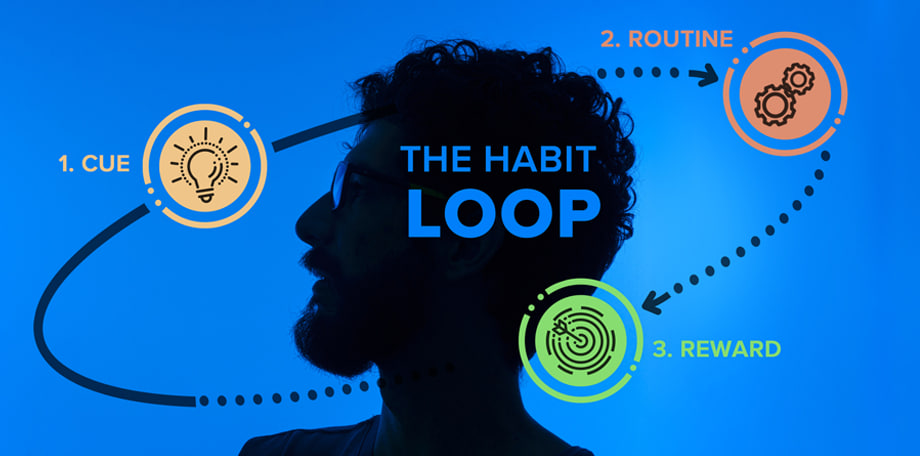
If you want leverage, you need to understand the system. Every habit—good or bad—runs through the same three-part neurological loop. Time, context, and personality don’t change this structure.
Let’s break it down and pinpoint where transformation actually happens.
1. The Cue: What Flips the Switch
The cue is the signal that tells your brain, “Run the script.” Most cues fall into one of five categories:
- Location: Walking into the kitchen sparks the urge to snack.
- Time: A specific hour triggers a familiar behavior.
- Emotional state: Stress, boredom, or anxiety.
- People: Certain social circles activate predictable patterns.
- Preceding action: Checking your phone immediately after waking up.
2. The Routine: The Behavior That Follows
This is the action itself, and it doesn’t have to be physical:
- Physical routines: Exercising—or avoiding it.
- Mental routines: Spiraling into self-doubt when challenged.
- Emotional routines: Reacting defensively to feedback.
3. The Reward: What the Brain Gains
No reward, no habit. The reward teaches the brain whether a behavior is worth repeating. Common rewards include:
- Physical relief: Quenching thirst or releasing tension.
- Emotional payoff: Pride, comfort, distraction.
- Pain reduction: Escaping stress, boredom, or discomfort.
"The habit loop consists of three elements: the cue (the trigger), the routine (the behavior), and the reward (the positive outcome that reinforces the behavior in the brain). Understanding this cause-and-effect relationship is the first step toward successfully building new habits".
5 Practical Steps to Reprogram Your Mind
Awareness alone doesn’t create change. Execution does—and execution needs a system. Habit change isn’t a dramatic breakthrough; it’s closer to precision engineering. Slow, deliberate, and repeatable.
Here’s a science-backed roadmap.
1. Identify the Current Loop and Track Your Cues
Start by observing, not fixing. Clarity comes first:
- Write down the habits you want to change.
- Identify the cue that immediately precedes it.
- Test the real reward: Are you eating because you’re hungry, or because you’re seeking comfort?
2. Swap the Routine, Keep the Reward
This is the golden rule: don’t delete the habit, redirect it, try this framework:
- Cue (unchanged): Feeling stressed.
- Routine (new): Deep breathing instead of smoking.
- Reward (unchanged): A sense of calm.
3. Theoretical Proof: Why Gradual Change Works
A study cited by Healthline confirms that starting with small habits is the key to success. The science behind this approach includes:
- Avoiding nervous system resistance to sudden change.
- Building confidence through small, daily wins.
- Making consistency easier and reducing psychological friction.
4. Practical Evidence: Corporate Success Stories
Global companies such as Starbucks have implemented positive routine systems to enhance performance by:
- Training employees on a specific response routine when dealing with angry customers (the cue).
- Introducing a new routine focused on calm listening and measured apologies.
- Achieving improved service quality and more substantial brand value under pressure.
5. Engineer Your Environment
Make good habits unavoidable and bad ones inconvenient:
- Keep fruit visible if you want to eat healthier.
- Charge your phone outside the bedroom to protect your sleep.
- Lay out workout clothes before bed to remove morning friction.
"An effective habit-change plan involves identifying the trigger (cue) and replacing a negative routine with a positive one while maintaining the same type of reward. This strategy leverages the brain’s flexibility, and research shows that repeating a new routine in a stable environment makes reprogramming the mind significantly easier".
Imagine Life with the Habit Loop on Your Side
Picture this: you wake up and move toward your goals almost automatically—no inner debate, no mental tug-of-war. Progress doesn’t depend on motivation spikes or perfect mornings. It happens because your system is doing the heavy lifting, especially on days when your energy is low and your mind is crowded.
That’s what real success looks like. Not heroic self-control, but a structure that works with your brain instead of against it.
Here’s what changes once you take control of the habit loop.
The Upside: When Habits Start Working for You
When your habits are aligned with your goals, several shifts happen quietly—but powerfully:
- Willpower is reserved for high-stakes decisions rather than burned on everyday choices.
- Health and physical energy improve steadily, without extreme plans or short-term pushes.
- Professional performance sharpens, driven by deep focus that becomes a default setting, not a struggle.
The Downside: The Cost of Staying on Autopilot
When unhealthy habits continue to run unchecked, the consequences add up faster than most people expect:
- Minor daily missteps compound into repeated failure.
- Frustration grows as control over your career and direction slips away.
- Time and energy leak into activities that feel busy—but deliver no real return.
The Long-Term Impact of Habits: A Side-by-Side Reality Check
|
Dimension |
Positive Habits |
Negative Habits |
|
Mental effort |
Decreases over time (automatic). |
Increases (constant inner conflict). |
|
Self-confidence |
Very high. |
Low (self-blame). |
|
Results |
Cumulative success. |
Repeated setbacks. |
"Mastering the habit loop creates a quiet but profound upgrade in quality of life. Instead of draining willpower through daily battles, positive behaviors become automatic. Ignoring this mechanism keeps you locked into patterns that slowly undermine both professional performance and physical well-being"?
FAQs
1. How long does it really take to form a new habit?
Research by Lally suggests the average is around 66 days, not the often-quoted 21. The exact timeline depends on the complexity of the behavior and how consistently it’s repeated.
2. Can bad habits be eliminated entirely?
Neurologically, habits are not erased—stronger pathways replace them. The goal is to weaken the old loop by reinforcing a new one that offers a similar reward.
3. What role does reward play in mental programming?
The reward is the brain’s confirmation signal. It tells your nervous system, “This is worth repeating.” Without a meaningful reward, the loop never fully locks in.
Systems Beat Intentions
Mastering the habit loop is often the missing key behind doors that have stayed shut for years. Change doesn’t begin with force—it begins with awareness. It starts by identifying the cue, reshaping the routine, and ends with a reward that nudges your future in the right direction.
You don’t need to overhaul your entire life today. Start with one habit. Just one.
And if this resonated, ask yourself—and share it forward: Which routine will you change today.
This article was prepared by coach Adel Abbadi, a coach certified by Glowpass.



Stay Informed with the Latest Developments