

 Main menu
Break the Freeze: 7 Cognitive Biases That Lock Managers into Analysis Paralysis
Have you ever found yourself staring at your screen, buried under charts, dashboards, and “urgent” emails—yet completely unable to move? You know the decision matters. You know the data is there. And still, your mind hits pause.
That mental gridlock isn’t a sign of incompetence or lack of experience. It’s something far more subtle—and far more dangerous. What you’re facing is analysis paralysis, fueled not by missing information, but by cognitive biases quietly hijacking the managerial brain. These biases act like tinted lenses: they don’t block reality outright, but they warp it just enough to keep you stuck.
The good news? Once you can see these illusions clearly, they lose their grip. Let’s unpack how analysis paralysis really works—and how seven common cognitive biases quietly sabotage decision-making at the leadership level.
Analysis Paralysis: When Thinking Becomes the Enemy of Action
How many opportunities die not because they were bad ideas—but because they were examined to death? In modern management, decision-making often feels like trying to carry water in your hands: the harder you squeeze for certainty, the faster progress slips away.
This isn’t a personal shortcoming. It’s a predictable psychological response to complexity, pressure, and perceived risk. Analysis paralysis sits at the intersection of responsibility and fear—and cognitive biases are the accelerant.
What Analysis Paralysis Really Is?
At its core, analysis paralysis is overthinking disguised as diligence. It’s the cycle of endless data gathering, scenario modeling, and risk evaluation that ultimately results in no decision at all.
Leaders caught in this loop often convince themselves that one more report, one more data point, or one more meeting will unlock clarity. In reality, what’s holding them back isn’t uncertainty—it’s discomfort with commitment. Choosing means owning the outcome, and ownership carries consequences.
The “Perfect Choice” Fallacy
Beneath analysis paralysis lies a powerful illusion: the belief that somewhere out there is a flawless choice—high upside, low risk, zero regret. This “perfect decision” fantasy keeps leaders circling the runway, waiting for ideal conditions that never arrive.
Psychologist Barry Schwartz, in The Paradox of Choice, explains why this mindset backfires. More options don’t create freedom; they create friction. Too many choices lead to:
- Decision paralysis
- Lower satisfaction with outcomes
- Lingering regret—even after good decisions
It’s why choosing a streaming subscription can feel harder than choosing a strategic partner. The brain wasn’t designed for infinite comparison.
The Hidden Price of Delay: When Waiting Becomes the Costliest Choice
The real cost of analysis paralysis isn’t overtime or mental fatigue—it’s missed timing. In leadership, value doesn’t come from perfection; it comes from momentum.
When decisions stall—whether around:
- Launching a product
- Entering a new market
- Pursuing an acquisition
The market doesn’t wait. Competitors move. Windows close. A solid decision made today will almost always outperform a perfect decision made too late—or never made at all. This is how cognitive biases in management quietly translate into lost revenue, lost relevance, and lost ground.
"Analysis paralysis is a state of excessive thinking and data analysis that leads to an inability to make decisions due to fear of making mistakes. It often results from the desire to reach the “perfect choice” in an environment full of variables, causing missed opportunities and reduced productivity".
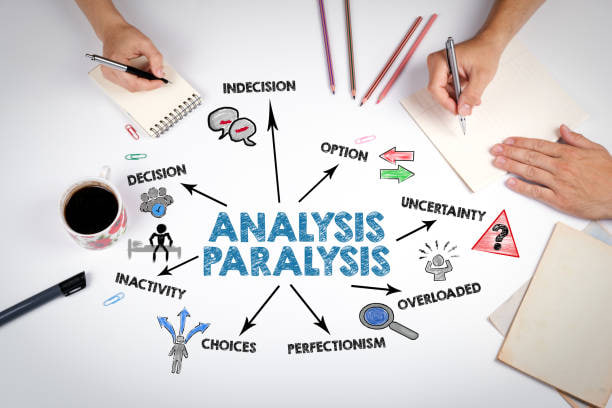
The Real Culprits: 7 Cognitive Biases That Sabotage Decisions
Analysis paralysis isn’t procrastination. It’s psychology. Below are seven deeply ingrained cognitive biases that distort judgment, inflate risk, and convince leaders they need “just a bit more data.”
Here are the root causes fueling cognitive biases in management and placing a barrier between you and effective decision-making:
1. Confirmation Bias: Listening Only to the Echo
- How it works: You seek information that agrees with your existing beliefs and dismiss signals that challenge them.
- The fallout: Decisions become exercises in self-validation rather than objective assessment, dragging analysis on longer than necessary.
2. Sunk Cost Fallacy: The Prison of Past Investments
This fallacy is one of the main drivers of managerial hesitation because it ties leaders to the past.
- How it works: You continue investing in a failing initiative simply because you’ve already invested so much.
- The fallout: Resources drain away while better opportunities pass by, all in the name of “not wasting” past effort.
3. Status Quo Bias: The Comfort of Standing Still
- How it works: You default to existing systems and strategies to avoid the discomfort of change.
- The fallout: Innovation stalls, adaptability erodes, and organizations slowly fall behind—without noticing the decline.
4. Anchoring Bias: Trapped by the First Number
- How it works: The first piece of information you encounter becomes a mental anchor—whether it deserves that weight or not.
- The fallout: Subsequent data is interpreted through a narrow frame, limiting creativity and distorting judgment.
5. Loss Aversion: When Fear Outshouts Opportunity
This bias is foundational in behavioral psychology when it comes to risk avoidance.
- How it works: The pain of losing feels stronger than the joy of gaining.
- The fallout: Leaders adopt defensive strategies that protect the downside while quietly suffocating growth.
6. Survivorship Bias: Seeing Only the Winners
- How it works: You analyze companies that succeeded while ignoring those that failed using similar strategies.
- The fallout: Risk looks smaller than it really is, and decisions are based on incomplete narratives.
7. Bandwagon Effect: Herd Pressure
- How it works: You adopt strategies because they’re trendy or widely used.
- The fallout: Solutions that work elsewhere are forced into contexts where they don’t belong, wasting time and capital.
Awareness of these cognitive biases in management is your first step—but awareness alone is not enough. Action must follow.
"Key cognitive biases in management that hinder decision-making include confirmation bias (seeking agreeable information), the sunk cost fallacy (clinging to past failures), status quo bias (resistance to change), and loss aversion (exaggerated fear of risk)".
Scientific Strategies to Neutralize Biases
Now that we’ve named the real culprits—those quiet cognitive biases shaping decisions behind the scenes—it’s time to move from diagnosis to treatment. Neutralizing bias isn’t about “thinking harder.” It’s about engineering the decision-making process itself so it naturally resists distortion.
In other words, smart leaders don’t rely on willpower alone. They build systems that force objectivity, even when pressure is high, and certainty feels out of reach. Below are practical, field-tested strategies you can apply immediately to break analysis paralysis and restore momentum.
1. The Devil’s Advocate Rule: Make Dissent Mandatory
If confirmation bias thrives on agreement, dissent is its natural enemy. The Devil’s Advocate technique does exactly that by formally assigning a person—or even a rotating team—the explicit role of challenging the proposed decision. Their job isn’t to be “negative.” It’s to stress-test assumptions, surface blind spots, and actively look for reasons the decision could fail.
When disagreement becomes part of the process rather than a personal risk, decisions get sharper—and false confidence loses its grip.
2. Decide the Ending Before You Begin
One of the most effective ways to dismantle the sunk cost fallacy is to pre-commit to clear decision rules. Before launching any initiative, define objective criteria upfront:
- What success looks like
- What failure looks like
- How much time and money are you willing to spend
- When the plug gets pulled—no debate, no drama
These “kill points” remove emotion from the equation. When thresholds are crossed, the decision to stop isn’t personal—it’s procedural.
3. Trust the Numbers, Not the Narrative
Survivorship bias and the bandwagon effect flourish in story-driven cultures. The antidote is simple but powerful: anchor decisions in data, not anecdotes.
"That means shifting from “This worked for Company X” to “What does the broader data actually show?” Build habits around measurable indicators, comparative benchmarks, and objective metrics. Inspirational stories may motivate—but they should never steer the wheel".

FAQs
1. What is the difference between managerial intuition and cognitive bias?
Managerial intuition is the rapid recognition of patterns built upon deep experience. It can be valuable when time is limited or data is incomplete. Cognitive bias, by contrast, is a recurring thinking error that systematically distorts judgment. Intuition can sharpen decisions—but bias quietly corrodes them.
2. How can I determine if my team is experiencing groupthink?
If agreement comes too easily, debate feels uncomfortable, or opposing views disappear from the room, take it as a red flag. Healthy teams challenge ideas without challenging people. The fix? Reward thoughtful disagreement and make constructive critique a visible part of performance evaluation.
3. Can cognitive biases be eliminated?
No—and that’s not a failure. Cognitive biases are wired into the human brain. What can be done is to contain their influence through awareness, structured frameworks, and objective tools such as decision matrices and checklists. The goal isn’t to remove emotion—but to make sure logic has the final say.
A Decision That Moves Beats a Decision That Waits
Understanding cognitive biases in management gets you halfway there. The other half is courage—the willingness to act before conditions feel perfect. These mental traps don’t discriminate by title or experience; even seasoned executives fall into them. That’s because bias isn’t a flaw to eliminate—it’s a human tendency to manage.
Don’t let the illusion of perfection keep your best decisions trapped on the whiteboard. A good decision isn’t flawless; it’s visible in the real world, producing feedback, learning, and momentum. Apply these neutralization strategies today, break through managerial hesitation, and step fully into decisive leadership.
This article was prepared by coach Lama Al Tamimy, a coach certified by Glowpass.



Stay Informed with the Latest Developments