

 القائمة الرئيسية
The Planning Fallacy Trap: How to Build Timelines That Actually Hold
Have you ever felt a quiet rush of confidence while mapping out a flawless project timeline—only to end up sprinting toward the deadline with half the work still undone? If this sounds familiar, you’re not disorganized or careless. You’re human.
Despite experience, data, and best intentions, professionals across industries continue to underestimate how long things actually take. According to the Project Management Institute (PMI), a large share of projects miss their deadlines, with one recurring culprit at the center of the problem: the planning fallacy.
This article unpacks the planning fallacy from a scientific lens and translates that insight into practical, professional strategies you can actually use—without resorting to generic productivity hacks or unrealistic optimism.
What Is the Planning Fallacy—and How Does the “Optimism Illusion” Deceive You?
The human brain is exceptionally good at imagining successful outcomes. We picture the launch, the applause, the finished deliverable—clean, linear, and uninterrupted. What we rarely picture are the detours: revisions, interruptions, dependencies, fatigue, or the sheer friction of real work. This mismatch isn’t a planning flaw; it’s a cognitive one.
When estimating future tasks, we unconsciously privilege ideal scenarios and discount historical evidence. In other words, we plan as if everything will go right, even when experience quietly tells us it won’t. Psychologists refer to this distortion as an optimism illusion—a mental shortcut that favors hope over probability.
Below are the psychological forces that keep this illusion alive.
Optimism Bias: The Hidden Engine Behind Unrealistic Timelines
At the heart of the planning fallacy lies optimism bias—the tendency to believe that we are less likely than others to encounter setbacks. Its effects typically show up in three ways:
- Tunnel vision: We focus almost exclusively on the “success path,” assuming progress will be smooth and uninterrupted.
- Overconfidence inflation: We overestimate our ability to power through obstacles, regardless of their complexity or scale.
- Risk blindness: We treat delays as rare anomalies instead of predictable features of any meaningful project.
Why Past Experience Gets Ignored When Planning the Future
One of the strangest aspects of the planning fallacy is that it persists despite clear historical evidence. We’ve been late before. We’ve underestimated before. Yet we still plan as if this time will be different.
Here’s why:
- External excuses: Past delays are chalked up to “special circumstances” that we believe won’t repeat themselves.
- Selective memory: The brain recalls moments of momentum while quietly deleting the long stretches of friction and fatigue.
- Future-self fantasy: We imagine a more focused, faster, and more disciplined version of ourselves—one that doesn’t quite exist yet.
The term planning fallacy was introduced in 1979 by Nobel Prize–winning psychologist Daniel Kahneman. In one landmark study, students underestimated the time required to complete their theses by roughly 30%. Even their most pessimistic predictions turned out to be overly optimistic.
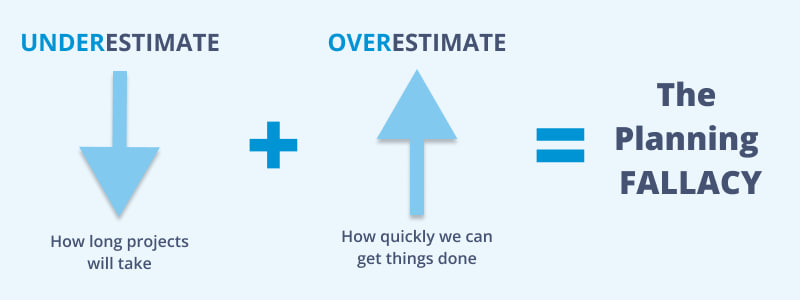
"The planning fallacy is a cognitive bias that leads people to underestimate task duration by focusing on best-case scenarios while ignoring predictable obstacles, resulting in missed deadlines and increased stress".
The Professional Cost of Getting Time Wrong
Poor time estimation isn’t just a scheduling issue—it’s a credibility issue.
Repeatedly missing deadlines sends a quiet but damaging signal: your commitments can’t be trusted. Over time, this erodes professional relationships, destabilizes teams, and increases psychological strain.
Here’s how the damage typically unfolds:
|
Area of Impact |
Immediate Outcome |
Long-Term Effect |
|
Client relationships |
Repeated delivery delays |
Loss of credibility and brand reputation |
|
Mental health |
Increased daily stress and anxiety |
Burnout and reduced productivity |
|
Financial performance |
Monetary penalties for delays |
Erosion of profits and loss of growth opportunities |
Real-world example: The Sydney Opera House stands as one of the most famous examples of planning failure. Initially slated to open in 1963 with a budget of $7 million, it was completed a decade later, at a final cost of $102 million. Vision wasn’t the problem. Time estimation was.
"The consequences of the planning fallacy extend far beyond minor delays. Inaccurate timelines undermine professional trust, intensify psychological pressure, and cost organizations millions—while quietly limiting individual growth and effectiveness".
Reference Class Forecasting
Breaking the cycle of inaccurate time estimates requires a fundamental shift in how we plan. Instead of inside planning—where tasks are treated as unique, emotionally charged exceptions—we need outside planning. The key move is simple but powerful: stop seeing the current task as special, and start treating it as a data point.
This perspective shields your planning process from mood, pressure, and overconfidence. When hard numbers replace intuition, accuracy improves dramatically. Here’s how reference class forecasting works—and how to put it into practice.
What Is Reference Class Forecasting—and Why It’s Not Guesswork?
Reference class forecasting is grounded in statistical realism, not personal optimism. Rather than asking, “How long do I think this will take?”, it asks, “How long did similar work actually take under real conditions?”
Its strength lies in three core principles:
- Radical objectivity: Estimates are based on verified outcomes from comparable past projects—not aspirations or best intentions.
- Emotional insulation: Enthusiasm, pressure, and deadline anxiety are deliberately removed from the equation.
- Whole-picture thinking: Delays, failures, and friction experienced by others are treated as expected inputs, not inconvenient surprises.
How to Use Reference Class Forecasting in Professional Time Estimation?
To apply this method effectively and neutralize the planning fallacy, follow these steps without negotiation:
- Select the reference class: Identify a group of past tasks that closely resemble your current project in scope and conditions.
- Extract the numbers: Determine the average actual time those tasks took, based on real records.
- Set the baseline: Use this average as the non-negotiable baseline for your new plan—without attempting to shrink it.
In this context, a study by Professor Bent Flyvbjerg demonstrated that using reference class forecasting can reduce estimation errors in large-scale projects by up to 40%.
"Reference class forecasting is the most accurate solution to the planning fallacy. It works by treating the current task as part of a broader class of similar past tasks and using their actual average completion times rather than relying on personal intuition".
Practical Steps to Design a Timeline That Doesn’t Fail
Understanding the science is only half the work. The real shift happens when you design timelines that defend against human bias by default.
Effective planning isn’t about discipline or willpower. It’s a system built on realism, modularity, and a healthy distrust of our own optimism. The following mechanisms help create timelines that bend—but don’t break.
A Professional Action Plan to Escape the Timing Trap
|
Practical Action |
How to Apply It |
Expected Benefit |
|
Buffer Time Rule |
Add a 25% safety margin to every scheduled task. |
Absorbing shocks and unexpected emergencies. |
|
Task Granularity |
Break large tasks into micro-units that do not exceed 2 hours each. |
Revealing hidden obstacles and improving estimation accuracy. |
|
External Observer |
Share your timeline with a neutral colleague for honest feedback. |
Gaining an objective perspective free from optimism bias. |
|
Actual Time Tracking |
Use tools like Toggl to monitor real performance. |
Building an accurate long-term database of time metrics. |
"To avoid planning failure, tasks should be broken down into very small units and supported with buffer time. Seeking feedback from a neutral third party is also recommended, as outsiders are often more objective in identifying obstacles than the task owner".

FAQs
1. Does the planning fallacy mean I’m a disorganized person?
Not at all. The planning fallacy is a universal cognitive bias that affects novices and experts alike. The difference lies in whether you use bias-correction tools like reference class forecasting.
2. How can I apply reference class forecasting to simple daily tasks?
Yes. Review emails, calendars, or past notes for similar tasks. Use their actual duration as today’s baseline instead of relying on how fast you feel you’ll be.
3. What are the best digital tools to counter the planning fallacy?
Time-tracking apps build reference-class data, while platforms like Asana or Notion help decompose work, surface hidden steps, and distribute effort more realistically.
Realism Is a Professional Advantage
Acknowledging the planning fallacy isn’t an admission of weakness—it’s a mark of professional maturity.
Relying on historical data, building buffers, and breaking work into realistic units doesn’t limit ambition. It protects it. Sustainable performance comes not from heroic overconfidence, but from systems that work even on imperfect days.
Start now.
If your current schedule feels tight or unrealistic, choose just one task. Break it into micro-tasks. Add a 25% buffer. Then pause and reflect: did your sense of control improve?
That shift—from pressure to predictability—is where real productivity begins.
This article was prepared by coach Lama Al Tamimy, a coach certified by Glowpass.



کن على إطلاع بأحدث المتسجدات